

Radiomuseet: The radio and the stories
By Ertuğrul Levendoğlu • December 18, 2025 • 6 min read • Local GuidePublished on Lindholmen Innovation District
Matts
At the entrance to the museum, we are greeted by Matts, with his snow-white hair and cheerful face, and after a brief introduction our tour begins. In the first corridor, we are met by historic radios and record players from America, Germany and Sweden, lined up on both sides with their striking aesthetic designs. Matts mentions that one of the radios was donated by a woman about ten years ago. He explains that many of the devices in the museum have been donated by supporters. This is how they have built a vast and diverse collection consisting of radio and television sets, gramophones, telephones, phonographs and radio studio equipment, among other things.
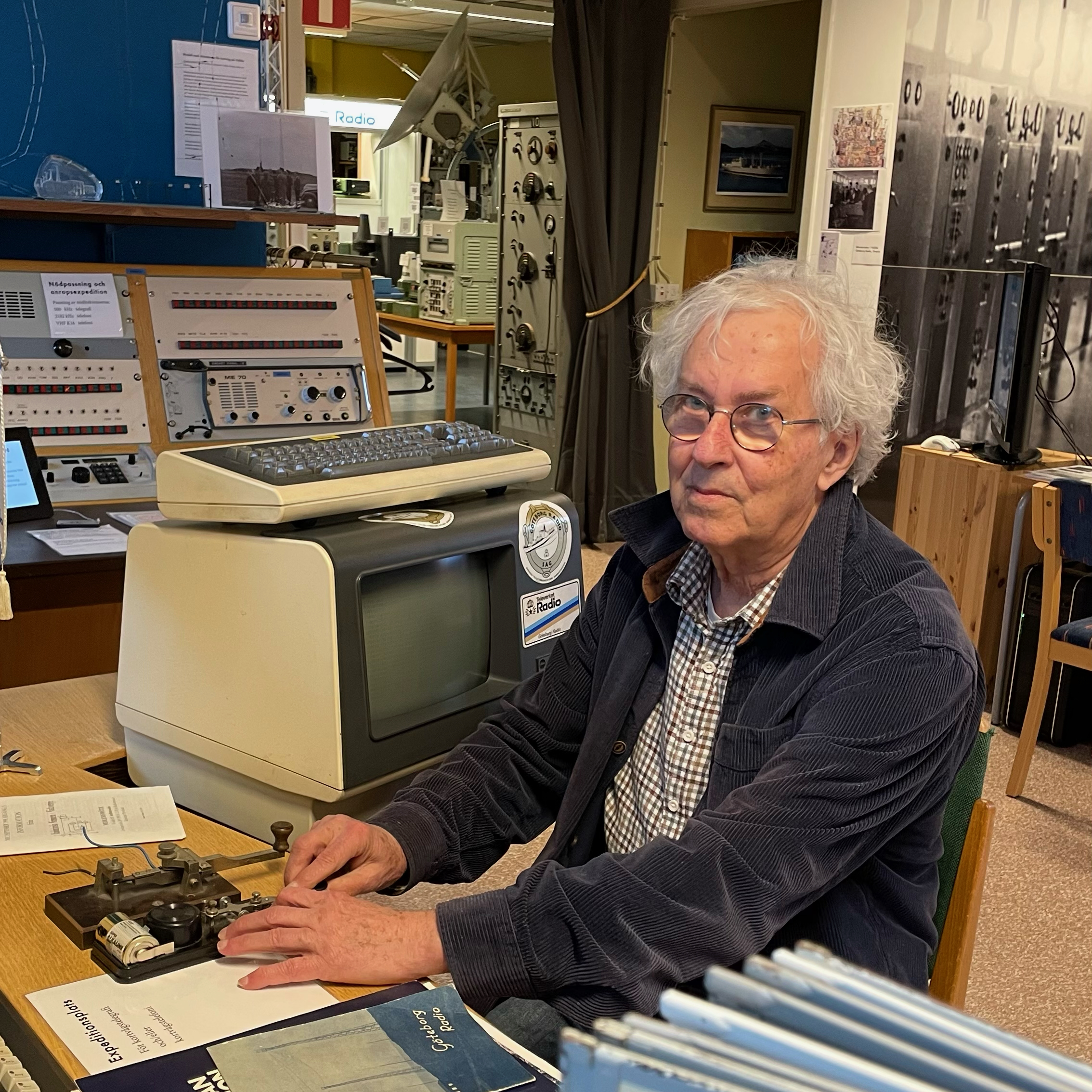
Today, historical documentary and film producers often find their way here. They borrow these rare, nostalgic devices to use as period-appropriate props in their productions. The award-winning Swedish drama series Vår tid är nu, which is set in the post-war period and the years that followed, is one of the productions that borrowed and used equipment from the museum during filming.
For the moment, we leave the radios behind, and Matts quickly heads toward the room in the middle of the corridor. I get the sense that he has something he wants to show us there. I follow him.
“That’s my ship”
Matts enthusiastically points into the room and says, “I have a cabin here. You can see my work there. I served in the navy between 1960 and 1964, when I was a radio officer.”
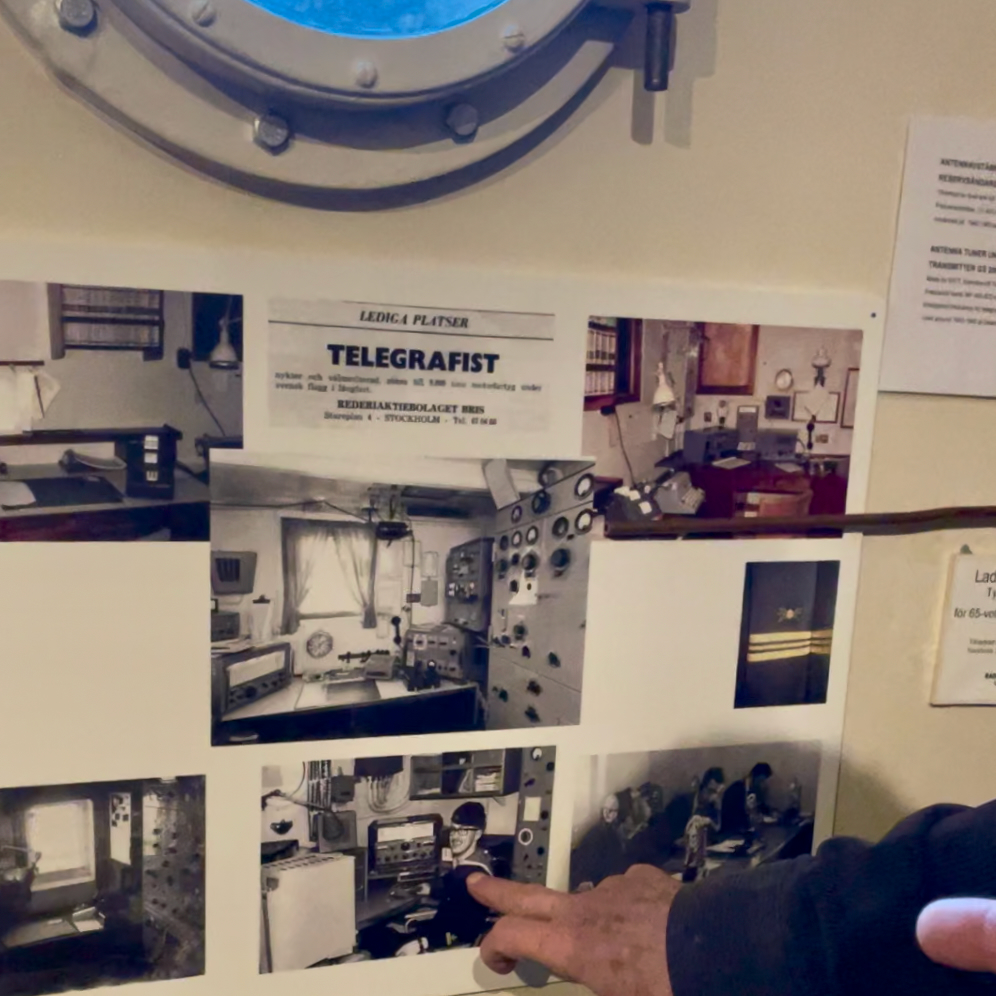
In this room, the radio station from the ship on which Matts served has been recreated.
Matts points to photographs on the wall and says, “That’s my ship, and this is the radio cabin where I worked.” He points to the young man in a naval uniform working inside the cabin in the photo and adds, “That’s me.” The adjacent photograph shows him and his classmates learning the Morse alphabet during a radio course run by the Swedish Radio Association in Gothenburg in 1961.
He then shows a picture of the ship they sailed to Australia with in 1961 and says, “That is Lonmaren, the ship I served on.” He smiles and adds, “Before Lonmaren, I was a ‘waist boy’ on Sunaren.” Matts’ seafaring adventures thus go back to well before his years as an officer.
As we move around the cabin, signal sounds can be heard in the background, like “di di dit dat dit...”. When I ask what these sounds are, he explains that they are news reports from that time, received from Gothenburg Radio via Morse code. Matts’ daily routine was to decode these telegram news messages from Gothenburg and convert them into text using his typewriter. He adds that he used to duplicate the translated bulletins with carbon paper and distribute them to the relevant personnel on board the ship.
Di di di daa daa da di di dit!
We then leave the room and move on to the section where the Gothenburg Radio Station of that era has been recreated. This time, Matts steps into the role of the radio operator who sent the messages to him by telegraph. He sits down in the operator’s chair and quickly encodes news reports in Morse code, “di di daa di...”. All these explanations must have taken him back to those years. His eyes light up as he recreates it all. As for me, I feel as though I am witnessing the communication traffic between the radio station and the ship right beside him.
He taps “Di di di daa daa da di di dit!” on the Morse key and says, “This is the SOS call,” then adds, “da da / da dit / da / da / dit dit dit,” smiling as he explains, “And this is Matts.”
He asks if I would like to try as well. I say yes and sit down in the radio operator’s chair. Even though I do not get it right the first time, with his help I manage to encode the SOS message on the second attempt. I do not even try to encode my long and unusual name. After all, I do not want to scare the people on board the ship! :D
QSL Cards
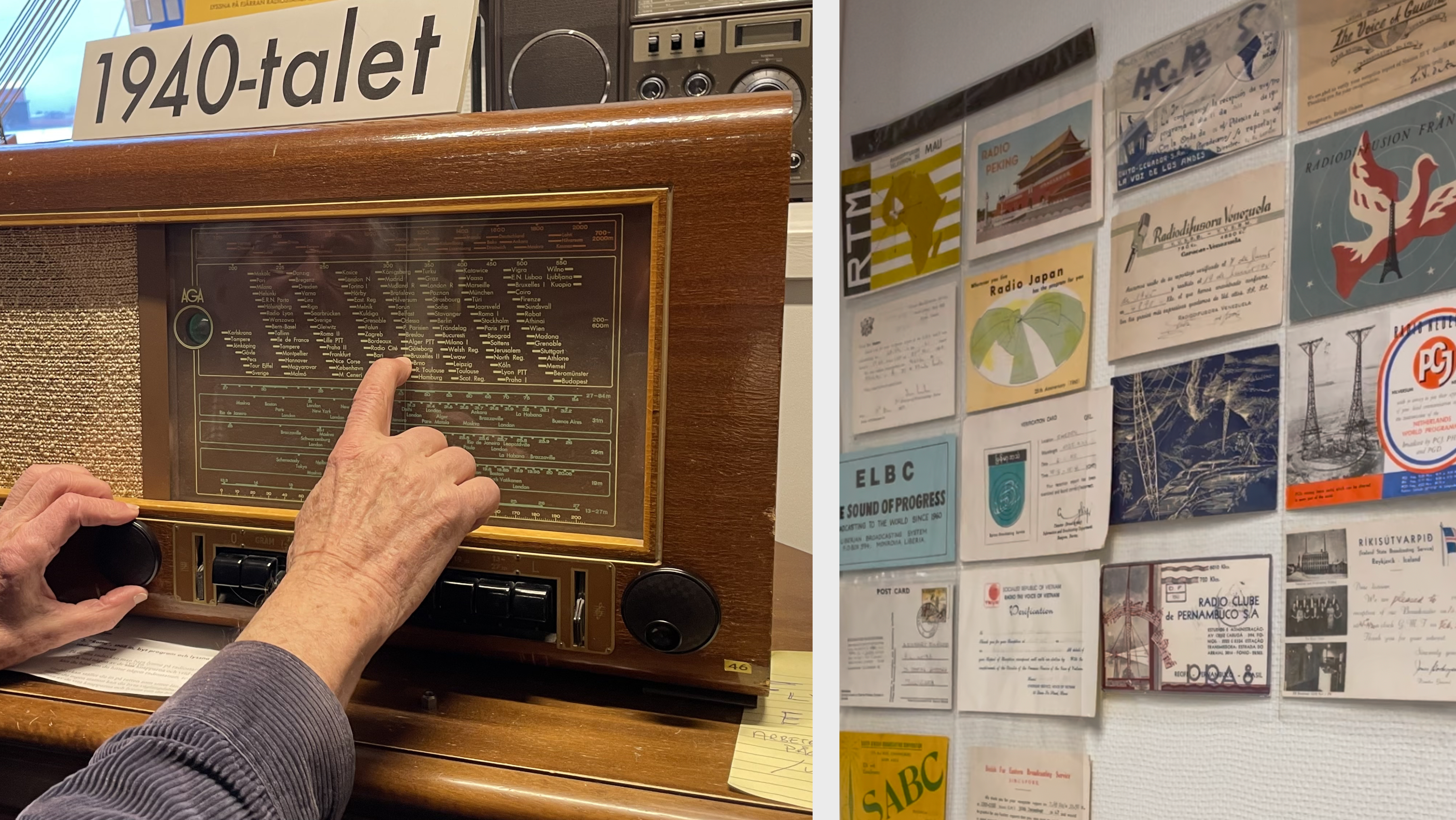
We return from Matts’ radio stations to the radio corridor. He points to an Aga radio from the 1940s and says, “This was the radio I wanted, but I never got it.” He adds that it was far too expensive for a ten-year-old. He then sits down by the radio and starts fiddling with the stations and settings. He says it is a very good radio for cultural broadcasts. And he slips back into those years, recalling, “Around Christmas, I would sit by the radio searching for different shortwave stations. When I found the BBC, I would send them a report saying, ‘I listened to you on this day, at this time, and the program was this.’ The BBC would then send me a QSL card. I collected 25 of those cards from different radio stations around the world.”
“You’ve never seen anything like this”
As we pass a German-made radio with an integrated Tefifon tape player, Matts says, “You’ve never seen anything like this.” Just then, Jarl, who had heard us from the other room, comes over and starts setting up the device, since this is his area of expertise. After inserting a cassette—which I had never seen anything like before—he turns a dial and comments on the song playing: “This is the radio version.” He then presses another button: “And this is from the recording.”
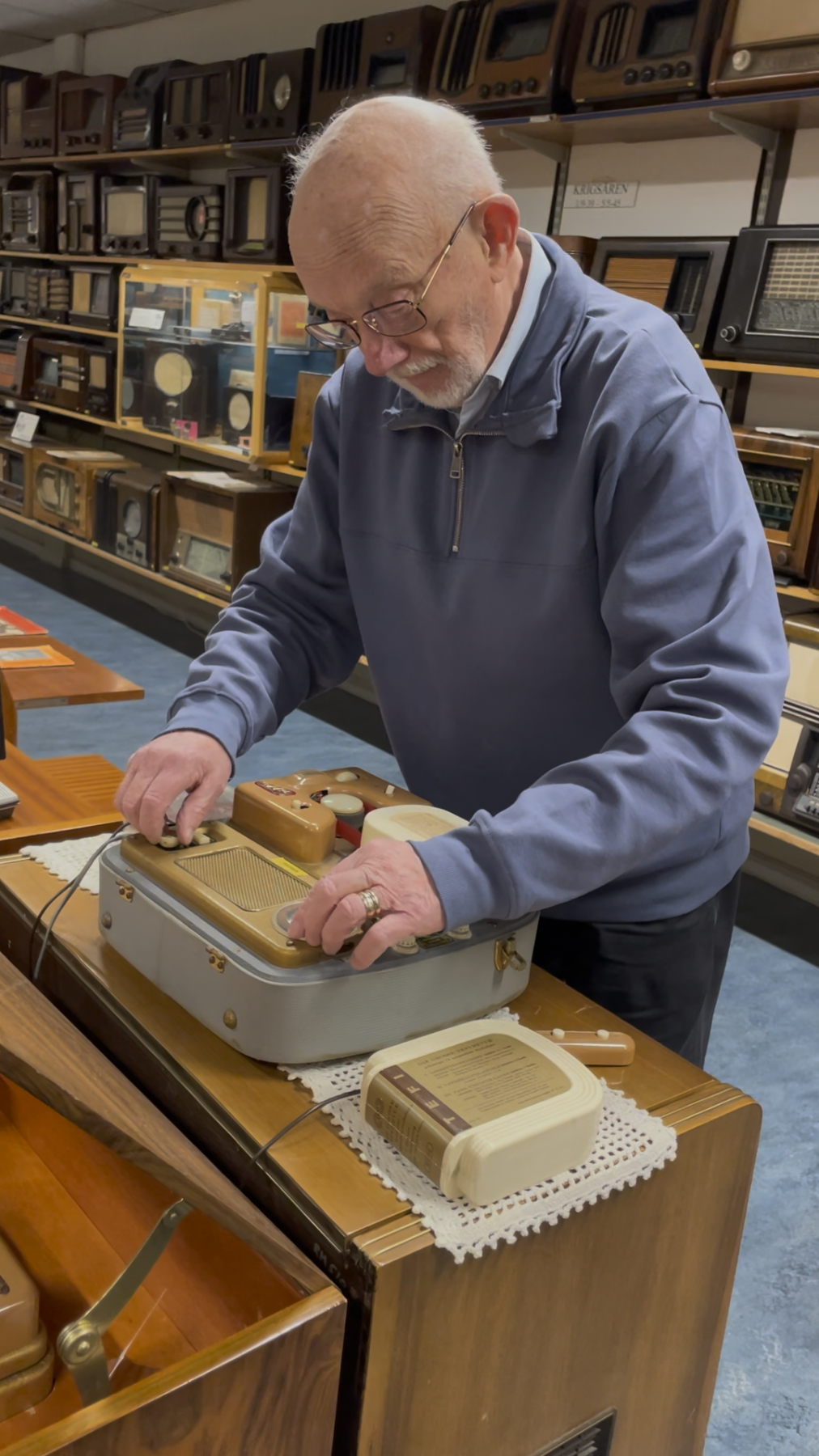
This cassette, which played on an endless loop, contained exactly 74 songs. Considering that it was a 1959 model, we can truly call it a remarkable technological achievement. Even more impressive was the device’s ability to skip songs. It’s brilliant! This radio/tape player was popular in places like restaurants at the time because of its song capacity and endless loop function.
Flickorna i Småland (The Girls in Småland)
And we arrive at the end of the museum—which is also its beginning. Here are the oldest items in the museum: the phonographs. Matts approaches an 1887 model developed by Thomas Edison, whose crackling, low sound we can hear. He says, “It’s not Hi-Fi!” and we laugh.
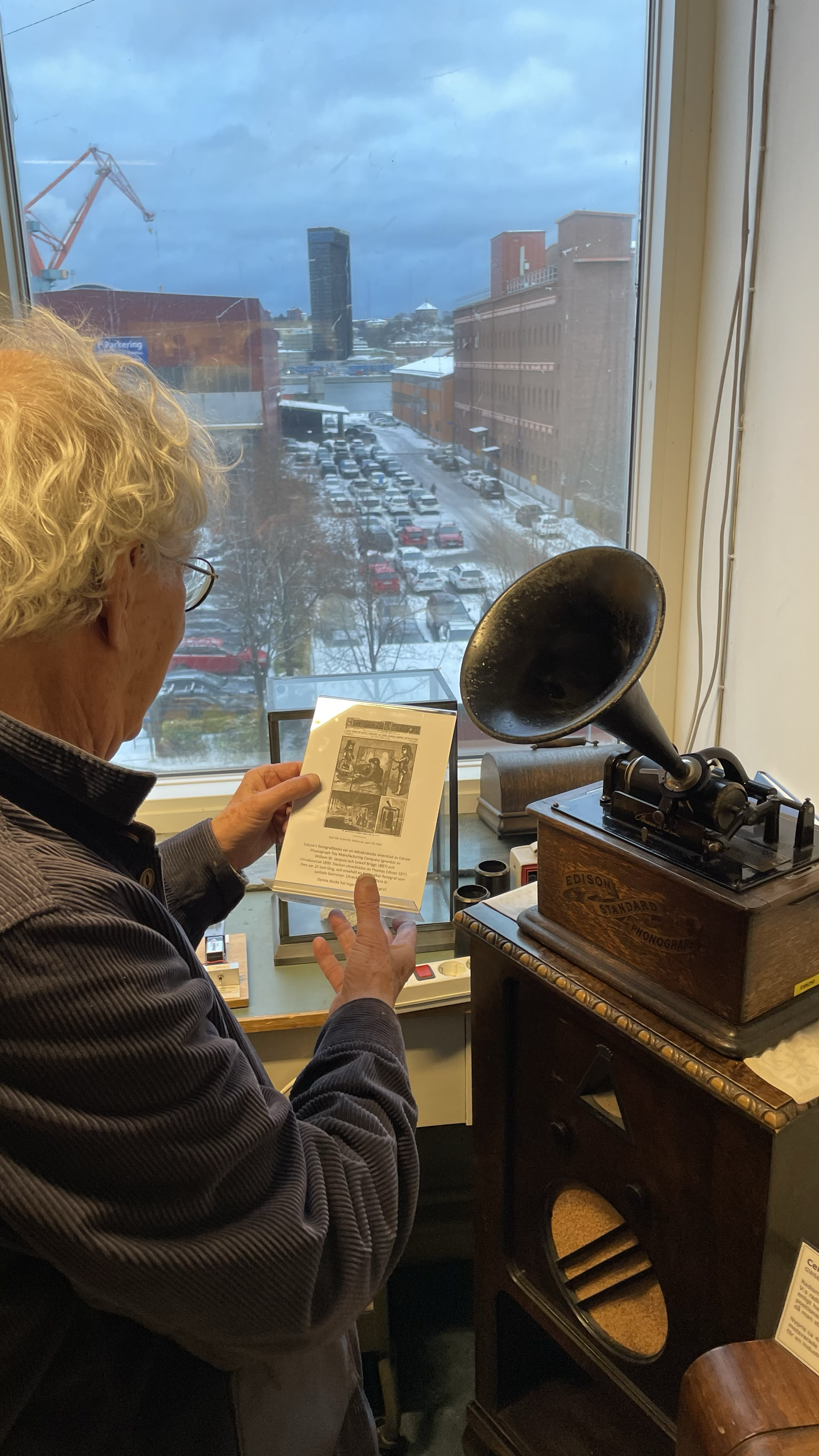
Matts points to the phonograph—behind which Lindholmen’s historic cranes and streets can be seen through the window—and begins to explain: “You can record your voice on these cylinders, and then you can play it back.”
He then winds up the gramophone next to it and starts playing. The music is jazz, and the song is in Swedish. “The group playing is the American ‘The Delta Rhythm Boys,’” he says. “They came to Sweden many times from the 1950s onward and later became regular performers here. During this time, they also recorded songs in Swedish. Maybe they fell in love with Swedish girls,” Matts suggests, as the song continues to play in the background:
…Yes, it’s the girls in Småland, Susilull and susilo, wandering
And singing along on the resting moor…
These were just a few of the stories I encountered at the Radio Museum, along with radios, telegraphs, and phonographs. Much more awaits you here.
We would like to thank Matts Brunnegård for his wonderful guidance and shared memories, and Jarl Svensson for his technical explanations. You can follow the Radio Museum via the link below and get in touch with them.